
I’ve covered many killers and gruesome attacks, interviewed murderers whose eyes resemble a grey scale more than any green or blue, and written stories captivating the drama of their crimes. This story, however, didn’t excite me the way the others did; it wasn’t as much of an ordeal. That was, until I arrived in Harrington, Iowa, and became captivated by the complexity of this seemingly mundane story.
Carl Simmons was on trial in New York City because, by the age of 31, he had gotten away with murder eight times. His face was plastered across every newspaper and news channel as journalists, myself included, tried to infiltrate the courthouse he was being tried in. Working for a big newspaper usually had its perks when it came to getting the story no one else could, but as everyone was covering Carl Simmons’ crimes, my boss wanted to go a different route and tell the story of a murderer’s childhood. This led to my 17 hour trek to the corn state, during which I had a strange overnight stay in the bland town of Fulton County, Ohio. The owner of the quaint and run down bed-and-breakfast I stopped in was convinced he saw the future, rambling on and on through the entire 11 hours of my stay about a vision he had the night before. He told me I was to be murdered in the exact way Carl Simmons executed his victims, with a knife through the heart like one would stake a vampire. Irked and overly tired, I simply thanked him for the warning, told him he should get out of the hotel business, and left as quickly as possible the next morning.
The town of Harrington seemed frozen in time when I arrived on the morning of the sixth. Most of the shop signs had not been updated from their originals, which must have dated back to the sixties and seventies. The houses were almost identical to each other, the only major differences being the colors of the shutters or the cars parked in the driveways. As I drove towards the town inn (which upon reflection, was the most ordinary part of my stay), I couldn’t stop my mind from jumping to the conclusion that it made sense that Simmons grew up in a place like Harrington.
When researching Simmons before my trip to Iowa, I watched almost every interview of him after his arrest. He was an awkward looking man, his head too small for his shoulders and his arms too long for his torso. It is said that looking a killer in the eyes is like looking into a void, that a person who is able to take another person's life as Carl Simmons did has a lack of color and light in their eyes. However, this method of detection is almost lost on Simmons because when talking to another person, he never makes eye contact. Instead, he will look at his fiddling hands, or the cracking ceiling of the interrogation room, or a spot just over the opposite person's head to give the illusion of eye contact without actually doing so. His uncomfortable disposition is no reflection of his violent nature, in which he felt a compulsion to control his victims, to make them see him as something other than awkward Carl while he held their fate in his hands. I can only assume his need for power was rooted in feeling powerless in a town like Harrington.
When I first walked into the inn, I was greeted by a small old lady named Barbra Smith. The woman looked to be in her eighties, hunched over a walker with round glasses that made her eyes seem too big for her wrinkled face. (About seventeen years ago on my second visit to Harrington, I was startled by a younger voice greeting me as I walked into the inn. When I asked the woman behind the front desk where Barbra was, she gave me a confused expression and a hesitant answer; “She died nine years ago, she was ninety-four.”). She made sweet small talk as I checked in, asking where I was coming from and why Harrington, and I gave her the regular spiel: “I’m a journalist from New York, and I’m currently working on a story about Carl Simmons and his childhood.”
“Well,” she started melodramatically, hand over heart as she leaned in as one would to tell a secret, “I knew Carl when he was a boy, and let me tell you it doesn’t surprise me in the slightest that he ended up the way he did.” I egged her on, asking how she knew him. She laughed in a way that said ‘you’re obviously new here otherwise you wouldn’t be asking such an absurd question’. “Everybody knows everybody in a town like Harrington, dear. But besides that, his father used to come to the inn every couple of weekends, usually with some girl he brought back from the city. He was a nasty man, but he was all that boy ever had,” after which she ended the conversation and began recommending regular town places one should visit, like the local coffee shop and bookstore. Looking back as a retired journalist, I can’t help but curse myself for not taking the opportunity to milk the woman for more information on Simmons, but I had been traveling for nearly two days and could barely keep my eyes open, so instead I stumbled into my room like a drunken sleepwalker and slept for nearly fifteen hours, waking up at ten the next morning.
Before beginning my day of digging on Carl, I ate breakfast in the small dining area attached to the back of the inn’s lobby. The room barely fit the five tables that were placed awkwardly close to one another, each sitting no more than two people. It was decorated like the rest of the inn was; in various different hues and shades of browns. The wallpaper was peeling slightly in the corners of the room and the hardwood floors were scuffed and scratched in various different places. A scent of burnt coffee and oak scented candles wafted through the room, slapping you in the face with a forced-cozy aroma as you walked through the door. Surprisingly, all but one of the tables were taken, which meant I was squeezing into one of the center tables. To my right were two men who each must have been a full four or five inches taller than me (I myself was just under six feet tall in my twenties). After ordering the “All-American Breakfast” off the limited menu, one of the men turned to me and said:
“So heard you’re writing ‘bout that Simmons kid, I’ll tell ya doesn’t surprise us one bit he’s spending the rest of his life in a cage,” turning to give the other man a grin as they both chuckle.
“You knew Carl Simmons?” I asked.
“He was in our grade in school, man I’ll tell you, I've never seen a kid get so excited to dissect a frog in biology before,” the second man responded. Even though he must’ve been only an inch taller than his friend, he felt bigger. He took up space, his presence looming, a silent threat.
“Hey I remember that day, kid was such a freak, we left him in that locker for the rest of the day, poor janitor - what was his name, Larry? Garry? - anyways, he’s the one who found him,” the other one laughed like a hyena would howl, startling those around us with its volume.
“You left him in a locker?” I asked, trying to mask the judgment in my voice.
“For a whole day. Guy deserved it though, don’t worry,” he continued, cocky grin displaying his crooked teeth never leaving his face. “Ya know what, lemme give you something to write about that creep right now: Carl Simmons was a nasty little kid who grew up to be just like his old man: pathetic. And you can quote Ram and Kurk on that.”
Later in my visit I met another former attendee of Harrington schools named Lara Davis, who had dyed blonde hair that nearly blinded me in the sun and artificially pink lips. She told me Ram Kelly and Kurk Sweeney did a lot more than just leave Carl Simmons in lockers; the bullying was incessant, and torturing Carl Simmons was their twisted form of entertainment. Lara Davis told me (whilst laughing and popping her gum like a teenage girl) that the two boys once got their entire grade to ignore Carl's presence for an entire week. On the rare occasion he spoke to someone, or raised his hand in class, people would pretend to simply not hear him, like he was a ghost that haunted their school.
After my breakfast with the 31 year old bullies, I made my way over to Orange Street, which was just a few blocks away from town square. I stopped in front of a run down house, with chipping paint along the walls of the house, loose shingles and yellowing grass. As I pulled out my camera to snap a picture of the house that the infamous serial killer grew up in, where his violent urges originated and fermented like weeds that were never pruned, until I was startled by a rather perky voice.
“Hi there! What can I do for you?” I could practically sense the whiteness of her and her husband's teeth before I turned to see their pristine smiles. The woman was wearing perfectly fitted jeans alongside a completely unwrinkled blouse, and the man was wearing white trousers and an uncomfortably buttoned up salmon-colored collared shirt. We exchanged polite introductions, shaking hands as they told me their names were Betty and Arthur Johnson. When I told them why I was in Harrington, their forced smiles turned into faux frowns, and their wide eyes seemed to twitch slightly at the sound of the name “Simmons”. “It's just tragic, no? I mean, all those poor girls he killed-I’m sorry it just makes me so sick,” the wife said, handing over her heart as she turned into her husband's arms in despair.
“We always knew something was off with that man, this just proves we were right,” the husband chimes in, an angry expression on his face as he pulls his wife closer into his side.
“You knew Carl Simmons?” I asked carefully, not sure what kind of answer I would get after my interaction with Ram and Kurk that morning.
“Of course we knew Carl, he was always the weird kid next door,” the husband starts, his expression darkening slightly. “My parents owned this house before my wife and I moved in, and I grew up with a window facing Carl Simmons. He was always just a little too close for comfort. I remember in middle school, whenever my friends and I would play catch or whatever twelve year olds do outside, we’d see him lurking on his porch outside, just watching us like a stalker.” He shuddered at the memory, and before I could stop myself, I was asking,
“Do you think he maybe just wanted to be included?” Arthur Johnson’s eyes swelled, and steam blew out of his ears like a train.
“The freak wasn’t ever included because he didn’t deserve to be, I mean come on look at where the lowlife ended up, a jail cell for Christ’s sake.” He was speaking with his hands like an angry politician. When he leaned in, finger pointed accusatorially, and said, “I remember when Betty and I were in high school, whenever she used to come over I’d see him watching us from his window. I was on the football team, and for the safety of my girlfriend, the guys and I taught him a lesson.”
When I think back on that conversation with the Johnsons, I don’t remember the fact that Arthur Johnson thought Carl Simmons was a stalker, I remember the look in his eyes. Behind his put-together expression, the star of the football team in high school graduated to dutiful husband act, I saw a puny man who even as a full adult looks back on a lonely middle schooler with mockery.
After I submitted my story on the 10th of that November in 2010, I took my last six vacation days to gather myself. I couldn’t fend off the crippling sympathy I felt for Carl Simmons, my heart reaching to embrace that small child subjected to the abuse of a drunken father and unaccepting community. My brain grasped and pulled at my heart, shielding it from the distasteful emotions it yearned to feel. Years later I still grapple with the darkness introduced to my soul on the day I pitied a murderer—the ink of humanity bleeding into my heart as my mind mourned its lost purity. While Carl Simmons rots in the confines of a maximum security prison in upstate New York, I’ve been splitting my heart in two at the expense of this humanity, going to war over truth and peace in my soul.
Short Stories
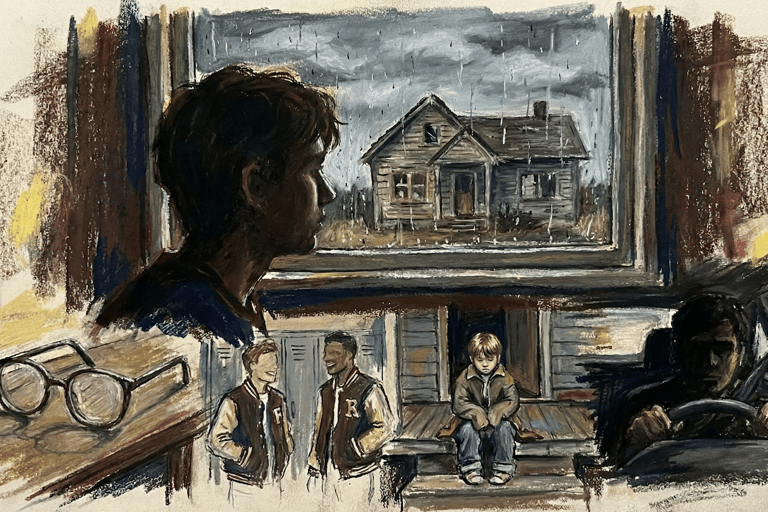
This short story was written for a class assignment with the objective of writing a story in a similar fashion as Gabriel García Márquez’s Chronicle of a Death Foretold.