
The city feels different after sunset. The lights seem brighter, harsh against the darkness of the night. They take on a physicality, bright and heavy and edible in a way that doesn’t exist when the sun occupies the sky. People become looser under the moonlight, drunk on the freedom the shadows allow, letting go of the realness daytime creates. Words and actions become temporary; once morning light hits and the world awakens, what happened under the shadows cast by skyscrapers and brownstones will be forgotten, a smudge in the memories of nights in New York City.
There is a saying: “The city will eat you alive.” I’ve heard this sentence all too often for my taste recently. What my persistent parents and doubtful friends do not understand is that it is too late for me; I am already completely and irrevocably consumed, and I am completely content with that fact. Living here has made me an addict, and leaving would send me into withdrawals. It beats you down, until you are broke and jobless, yet you never - cannot - leave. You never pack up that box-sized apartment in that mouse-infested building with a super who distinctly fits that stereotypical old New York super character one would expect to see in an old late-90s mob movie, and go back home where you are secure and comfortable. You will never go back home, despite not having a home here.
Currently I am walking, my preferred mode of transportation. Where, I am not quite sure. Nevertheless, I walk as a Marquez sleepwalker might: dazed without direction. My worn brown loafers, shoes I spent money I did not have to impress a publisher who politely pointed out each and every plothole and comma misuse in my novel, drag against the concrete sidewalk. The lights - blinding white from deli windows and neon green from the signs hanging outside smoke shops and dim, smoky yellow and orange hues pouring like fog out of the Italian restaurants and French bistros and elevated sports bars - cover me, tracking my movements as would a spotlight.
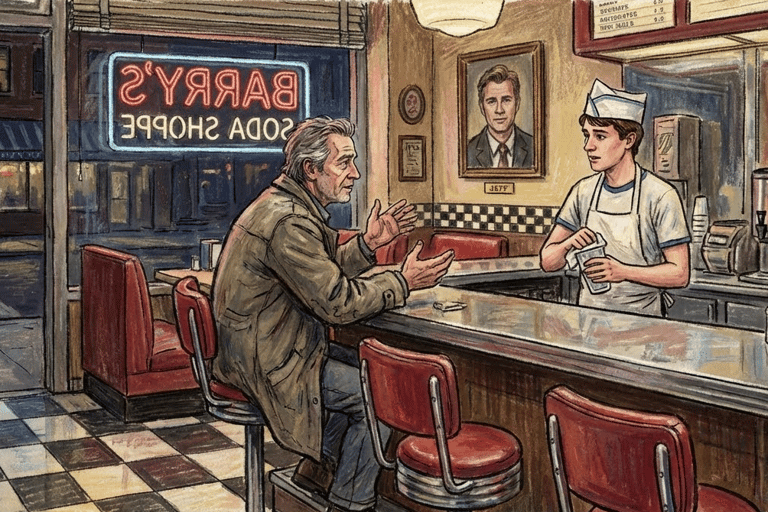
I finally stumble upon a familiar shade of red and white glowing against the heavy night sky: a sign written in a retro font reads: Barry’s Soda Shoppe. The dinky old diner has been run by the same family since it opened in the 1950s and has not been renovated since; this is the place where I spend most of my forlorn nights. The floor is checkered black and white in that comforting, traditional diner way. The tables are all a dark colored wood, the booth seats all covered with chipped vinyl in a bright, obnoxious red. I drag myself to a bar stool, one with the same vinyl cushioning the seat as the vinyl of the booths, leaning my hands on the cool metal countertop I can see my distorted reflection in. I spot my wristwatch - expensive when it was originally sold, however it was a mere $50.00 when I bought it from a thrift store in Brooklyn - and read the time: 11:47 pm. The soda shoppe closes at midnight, giving me thirteen minutes to drink my coffee and find my way back to my shoebox.
“Hey, Nolan my boy! Long day? Those eye bags get more and more purple each time you come in here, buddy.” A large man with a round belly with very little volume control walks out from the kitchen behind the counter. He is wearing the only attire that I’ve ever seen him wear: a white worn tee-shirt with a waiter's apron and a little paper hat with the logo of the shop printed on the side. He leans across the counter contrary to me, the rather unhygienic appearing rag he uses to clean glasses in hand. Jeffery, Jeff to all, and I have become well acquainted over the many hours I’ve spent sitting across the countertop from him. His grandfather was Barry of Barry’s Soda Shoppe.
“Hey Jeff,” I reply dully, the lingering melancholy of the day seeping through my pours alongside the sweat that began perspiration as soon as I walked in the door. The problem with winter in New York is that every restaurant, clothing store, coffee shop, apartment building, or any other interior space tends to blast heat in order to contrast the biting cold that exists outside. However, due to how many layers one must wear in order to fight said cold, it is difficult to regulate one’s body temperature. Therefore, sweating and overheating must become part of one's daily struggles during the colder months in the city. “Just a coffee, please.” I clasp my hands in front of my over the counter, letting the cool of the metal bleed into my hands. Exhaustion hit the moment I sat down. I lean forward, hunched, whether to remove the weight (both figurative and literal) off of my shoulders or to curl into myself, I am not too sure.
“You look like hell, kid, something happened?” Jeff has been the one constant friend I’ve had over the eight months since I moved here. In a depressing sort of way, he is the only one who knows me well enough to inquire whether or not something is wrong. He begins making my coffee (a splash of milk and nothing else), moving around behind the counter in a way that feels familiar.
Each day goes relatively as follows: I wake up at around 8:00 am, usually roll out of bed as an angry teenager would, make myself breakfast (something simple and cheap, like cereal) then walk the four blocks down to the soda shoppe. Each morning at 8:45 I pass the same woman (mid to late-fifties would be my guess) who always has a pinched expression on her face, as if she is perpetually disgusted, walking with a lanky dalmatian wearing a gold and maroon collar who closely resembles its owner, nose stuck up in the air in the same pretentious way. Every morning without a doubt, I tip my worn newsboy cap at the woman with a devilish grin on my face, and each morning her nose tilts a little higher in the air and her eyebrows draw as she pretends not to have seen me. Once I arrive at the diner, I order my coffee, sitting in the same seat I always do with a book or talking to Jeff. I then spend the rest of the day searching for places to write and edit my novel. Sometimes I stay at the diner, however that only lasts a short amount of time as I am easily distracted. Most often, I make my way to Central Park and find a quiet bench to write on, surrounded by the little green you can find on the island of Manhattan. I find I do my best writing sitting in the park, as I think the magic of such a wonderful place bleeds into the paper, infects the mind and creates something extraordinary. Otherwise, one can find me sitting inside a coffee shop or in a secluded corner of the New York public library (the grandiose nature of the place motivates me). A constant, no matter what occupies my daytime, is my inevitable return to the soda shoppe. Always, I am alone.
“Met with that publisher about my novel today,” I respond as he places the cup - one of my favorite things about this place is that the coffee cups are practically bowls - in front of me. “It seems that I am nothing but ordinary.” I run my finger along the worn ceramic cup, watching as the steam seeps out the top.
“What’s wrong with being ordinary?” His eyes are hard in a way I was not expecting to come with my confession. His harshness angers me, turns something inside my soul that has been bubbling throughout the course of the day.
“Ordinary means I am stuck scraping for pennies and tutoring high schoolers for some extra cash. Ordinary means I have no chance at becoming a published author, nevermind simply being a career writer. Ordinary means I gave up security, a life, back home for nothing in New York. Ordinary, my friend, is my inevitable doom.” My hands flail and point accusingly with my tantrum, a habit of mine my mother tells me I must work on losing as it makes me look like a child. I pause to sip my coffee, the heat of the cup unbearably uncomfortable within my hands.
“I suppose, yes, ordinary might not be the best thing a writer can be called. But I don’t think it means you made some big life-ruining mistake coming here to New York.” His voice has softened slightly since he last spoke, most likely startled by my sudden, rather embarrassing outburst. The vulnerability of the conversation chokes me, as truth might knock the wind out of one's chest.
“No?” I ask, eyebrows raised in tired inquiry.
“No, for sure no. If you never moved here, boy, you’d be living - no, rotting in that town back home wishing you had the guts to do something different, go against the grain, and make the move. You’d live out the rest of your days sad and angry and resentful that you didn’t, at the very least, try. And you know what, kid? I’m glad you tried, because you’re a helluva lot more interesting a person because of it.”
“Look, I’ve met a lot of people, you’re not the first or the only person to sit on that bar stool nor will you be the last. I might not be some big-shot publisher or the smartest guy on the planet, but I feel pretty confident when I say you are not ordinary, Nolan. Any ordinary person would not be here.”
This night is one that stuck in my consciousness, one that altered the chemistry of my brain, for many years to come. I did not leave New York after that fateful encounter with the publisher, and per Jeff’s advice I continued to work on my novel over the course of the next year. More times than not I’ve considered leaving, going back home to my parents house and living out of my childhood bedroom until I could secure a stable income. Each time I felt this urge I went back to the diner, sat on that red-vinyl covered barstool across the metal counter from Jeff and simply talked. He never told me I shouldn’t leave, or that I would be making a mistake if I did. Instead, he told me to try.
“Give it a few weeks, what’s the harm? You’ll still be broke by then, not like that’s changing in 14 days, and if you do end up going home at least you can say you tried.” Every time he’d present this advice in a casual manner, moving around behind that counter making coffee and writing orders. Each time I’d leave that diner equally confused, exceedingly frustrated, and all the more exhausted. I never did find it in me to leave.
Now, I have published three books, all with the same small, lesser-known publisher, yet a respectable publisher all the same. I have an agent named Maggy who has the same eclectic style as I and who happens to be my wife. We don’t live lavishly, however we are content all the same. I still visit the soda shoppe each morning and night, still feel the same sense of calm each time I am washed in the red and white lights of the store sign.
Jeff’s son Will now stands across the metal countertop, moving around working in that familiar way his father did. I am now the one giving existential advice, usually in a much more dramatic fashion than Jeff ever did.
I believe each person has a moment - a tangible point in the timeline of one's life which, if asked, they could circle or mark with an X to say that was when their life changed in some irrevocable way. My moment was that night in the diner with Jeff. Oftentimes I revisit Jeff’s advice when I feel alone in some critical way, when I walk the streets of the city under the artificial lights, questioning if I truly ever did have a home here, despite my perpetual stay.
Short Stories
This short story was written as a submission to the 2026 Scholastic Young Writers and Artists contest, which has yet to release its results.